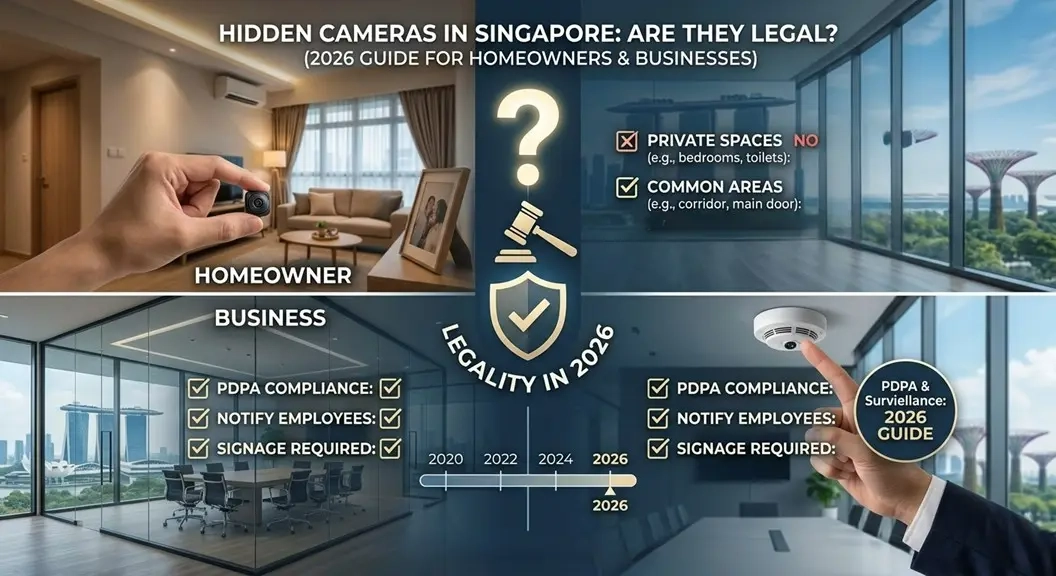
1. Singapore's voyeurism law
Section 377BB of Singapore's Penal Code 1871 addresses voyeurism. In broad terms, it covers specified intentional observation or recording of another person doing a private act without that person's consent, where the person responsible knows or has reason to believe that consent is absent. It also addresses operating equipment with the intention of enabling such observation.
Whether a particular incident falls within the offence depends on the facts and the wording of the law. Do not assume that every recording without consent is automatically voyeurism, or that a camera becomes lawful merely because it is installed for a stated security purpose.
- Placing a camera to observe someone in a bathroom or changing area may create serious criminal-law concerns.
- Recording people while they are changing clothes or engaging in another private act can raise serious legal issues.
- Using equipment to enable non-consensual observation may itself be relevant under the law, even where a recording is not made.
Read the current legislation directly: Penal Code 1871, section 377BB (Voyeurism). The Singapore Police Force also provides an overview of voyeurism and reporting concerns.
2. Does the PDPA apply to CCTV footage?
Video footage that identifies or can identify an individual may be personal data. For organisations, the Personal Data Protection Act (PDPA) may apply to how footage is collected, used, disclosed, protected and retained, subject to the Act's requirements and exceptions.
The position is not identical for every camera owner. PDPC guidance states that individuals acting in a personal or domestic capacity are excluded from the PDPA's data-protection obligations. Organisations that install CCTV for business, employment or other organisational purposes should assess their obligations separately. Consent, notification and exceptions depend on the particular circumstances.
- Define and document the purpose of CCTV before installation.
- Where applicable, provide appropriate notice about CCTV use and its purpose.
- Limit who can view or export recordings, and use reasonable security safeguards.
- Set a practical retention period and avoid keeping footage longer than necessary for the purpose.
- Consider whether the camera captures areas beyond the premises or records audio that is not needed.
For organisational CCTV use, refer to the PDPC Advisory Guidelines on the PDPA for Selected Topics (revised May 2024) and the Personal Data Protection Commission website.
3. Cameras in homes, workplaces and spaces used by others
Security concerns may arise in homes where helpers, cleaners, tenants, contractors or guests are present, as well as in offices or staff areas. A person's presence in a property does not, by itself, resolve every privacy or legal question.
As a cautious practical approach, avoid placing cameras in bathrooms, changing areas or other locations where people reasonably expect privacy. For household or workplace monitoring, consider the purpose, the camera's field of view, whether affected people should be informed, and whether a less intrusive method would meet the same security need.
Where there is a dispute, a specific employment arrangement, or uncertainty about whether a proposed setup is lawful, obtain advice from a qualified Singapore lawyer rather than relying on a general online guide.
4. Why covert surveillance can backfire
Even when the intention is to protect property, covert monitoring can lead to complaints, loss of trust, employment disputes or an investigation if the circumstances raise legal concerns. The outcome depends on the facts, including where the camera is placed, what it records, the purpose for using it and the applicable law.
Before buying or installing a camera, ask:
- What specific security problem am I trying to address?
- Could a visible camera positioned at the entrance or common area achieve the same goal?
- Could the field of view be narrowed to avoid private areas or neighbouring premises?
- Who will be able to access the footage, and how long will it be stored?
- Is audio recording necessary, or can it be disabled?
5. Safer alternatives to hidden cameras
For many security situations, a clearly positioned CCTV camera with a defined field of view is easier to explain and manage than covert surveillance. Compact cameras can still be discreet in appearance without being deliberately concealed to observe people in private situations.
- Entrances and exits: focus on access points and the activity relevant to the security purpose.
- Common areas: consider suitable views of living areas, shop floors, reception areas or stock areas, while avoiding spaces where privacy is expected.
- Transparent notice: where appropriate or legally required, inform relevant people that CCTV is in operation and explain its purpose.
- Secure remote access: use strong, unique passwords, keep firmware updated and restrict access to authorised users.
- Regular checks: confirm recording, storage, time settings and camera angles are working as intended.
Lion Securisia Engineering provides CCTV and security-system installation services for legitimate security needs. We recommend planning camera placement around the intended purpose, avoiding unnecessary intrusion into private areas, and considering applicable legal and privacy obligations before deployment. A camera's size or appearance does not determine whether a particular use is lawful.
Frequently asked questions
Is it illegal to own a hidden camera in Singapore?
Owning a camera is different from using it. There is no simple rule that every hidden camera is illegal to own, but a particular use can raise criminal or privacy issues depending on the location, intent, what is observed or recorded and the relevant law.
Can I install CCTV in my own home?
Home CCTV is commonly used for security, but placement and use still matter. Avoid private spaces such as bathrooms or changing areas, consider the privacy of household members and visitors, and check other applicable rules for the property and circumstances. The PDPA's data-protection obligations generally exclude an individual acting in a personal or domestic capacity, but that does not mean every possible camera use is lawful.
Does every CCTV camera require consent from everyone recorded?
Not in every situation. For organisations, consent and notification requirements depend on the PDPA and whether an applicable exception or other legal basis applies. The circumstances matter, so organisations should consult current PDPC guidance for their specific use.
Is a small or discreet camera automatically legal?
No. Size and appearance do not decide legality. The purpose, location, conduct being captured, consent and other circumstances matter. A discreet design should not be used as a way to observe people in private situations.
Where can I read the official rules?
Start with section 377BB of the Penal Code, the Singapore Police Force's voyeurism guidance, and the PDPC advisory guidelines on the PDPA for selected topics.
Conclusion
There is no one-size-fits-all answer to whether a hidden-camera setup is lawful in Singapore. Owning a device is not the same as using it in a particular way. Voyeurism law, personal-data rules that apply to organisations, privacy expectations and the exact circumstances can all matter. For routine security, start with a clearly defined purpose and a suitably positioned CCTV system that avoids unnecessary intrusion.
Lion Securisia Engineering can help assess CCTV coverage for homes and businesses in Singapore. Share your property type, areas to monitor and any floor plan or photos so the proposed system can be discussed in the context of your security needs.
Need a CCTV solution for your property?
Tell us whether the installation is for a home, shop, office or warehouse. We can discuss practical camera placement and a security setup appropriate to your site.
Important: This article is for general information only, not legal advice. Laws and guidance may change, and whether a particular setup is lawful depends on its specific facts. Consult a qualified Singapore lawyer for advice on a specific situation.