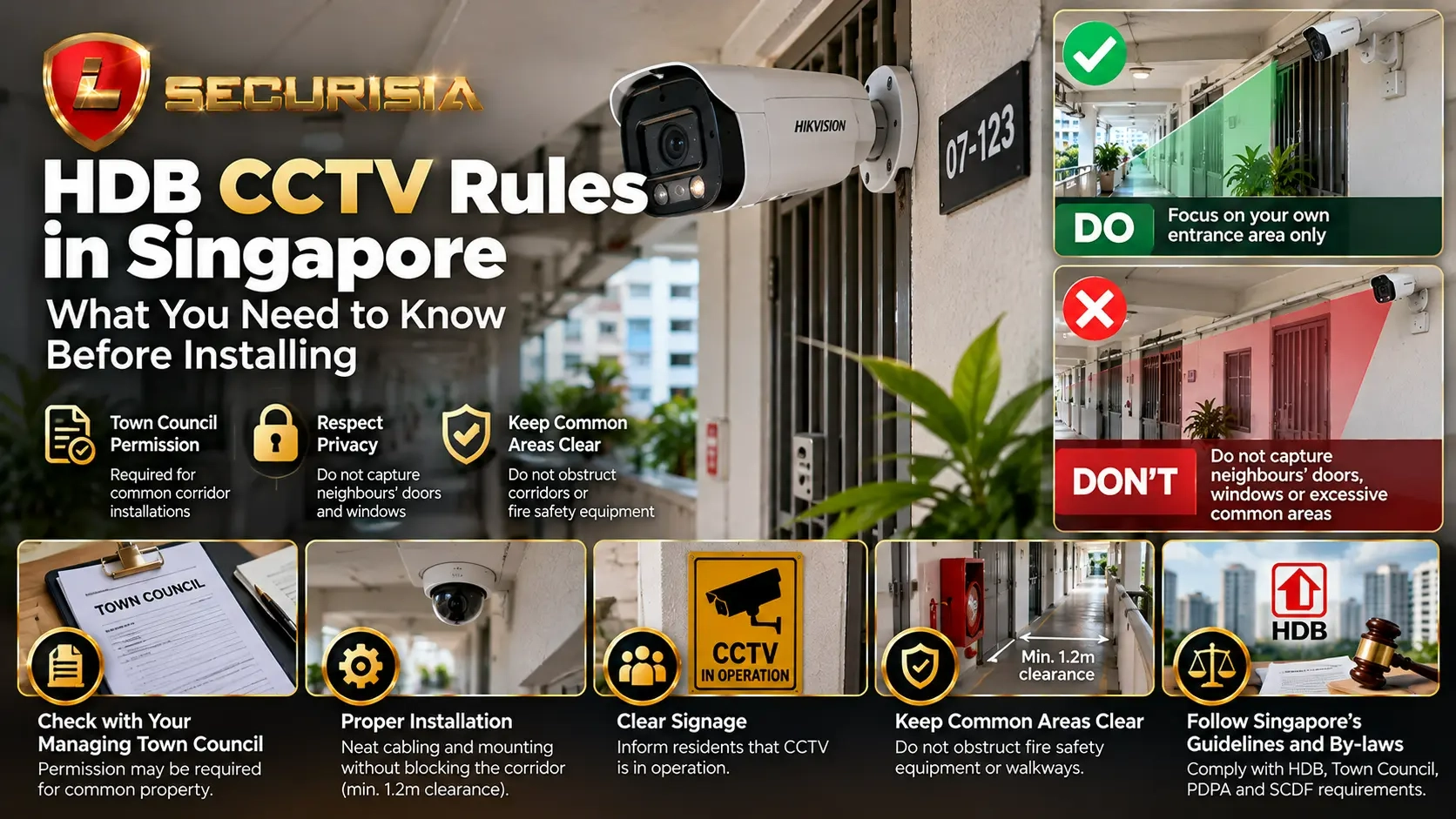
If you want to install a camera outside your HDB flat, including on or along a common corridor, contact your managing Town Council first and confirm the approval and installation conditions. HDB says standalone CCTV installed inside your flat does not require HDB approval, but it should not face another flat’s door or windows. Do not assume that an outside camera is automatically permitted.
1. Can I install CCTV outside my HDB flat?
Possibly, but you should not treat a common-corridor installation as automatically approved. HDB’s official guidance says residents who want CCTV outside their flat, such as along the common corridor, should approach their managing Town Council for advice. Common corridors are shared spaces, so the proposed camera, bracket, cable route and field of view need to be considered before installation.
Before buying equipment or drilling, send the Town Council a short description of the issue you want to address, the proposed mounting position, a photo of the doorway and corridor, and a sketch or screenshot showing the intended viewing angle. Ask what approval, supporting documents and conditions apply to your block.
2. Do I need Town Council approval for HDB corridor CCTV?
For a camera outside the flat, contact your managing Town Council first. The official HDB page directs residents to the Town Council for advice about CCTV outside the flat. The 2026 model by-laws also regulate fixtures installed on common property without permission. Your Town Council can tell you what is required for the location and proposed setup.
Do not rely only on a contractor’s assurance, a neighbour’s existing camera or an online forum post. Different blocks and installation circumstances can require different checks. Keep any written response or approval and follow any conditions given.
What should I send the Town Council?
- Your block and unit details, plus a contact number.
- A photo of the proposed camera position and the surrounding corridor.
- A simple drawing of the camera’s field of view.
- Details of the mounting method, cabling and whether any common property will be drilled or altered.
- A brief explanation of the safety concern, if relevant, and any incident reference details you are comfortable sharing.
3. Can my HDB CCTV camera face the common corridor?
Do not assume that a camera can record the whole corridor simply because the doorway is outside your unit. The acceptable field of view depends on the installation and any conditions imposed by the relevant authority. Keep the view as narrow as practical for the security purpose and avoid filming neighbours’ doors, windows or private activities.
A camera with a wide-angle lens can capture more than expected. Before installation, check the live view from the actual mounting height. If the camera supports privacy masking, use it where appropriate—but do not treat masking as a substitute for required permission.
| Planning question | Better practice |
|---|---|
| What needs to be visible? | Define the specific area needed for your security concern rather than recording as much of the corridor as possible. |
| Could another unit be recorded? | Review the live view from the installed position and adjust angle or privacy masking where supported. |
| Will equipment obstruct the corridor? | Keep the passage clear and ask the Town Council about mounting and cable routing. |
| Is approval needed? | Confirm with the Town Council before fixing equipment to common property. |
4. Can I install a CCTV camera inside my HDB flat?
HDB states that you do not need to seek HDB approval to install a standalone CCTV camera within your flat. HDB also says that such cameras should not face the door or windows of another flat, and that CCTV cameras should not be installed on the building façade.
For a camera mounted inside your own home, check the image on the app before finalising the position. If the camera is near the entrance, ensure the angle is focused on your own area and does not unnecessarily capture a neighbour’s private space.
5. Can my neighbour complain about my corridor CCTV?
A neighbour may raise concerns about privacy, the use of common property or obstruction. A well-intentioned security purpose does not automatically settle those concerns. Be prepared to explain what the camera records, why the view is needed, who can access footage and how long recordings are kept.
- Keep the camera view limited to the stated purpose.
- Avoid aiming at another unit’s door or windows.
- Use a strong account password and restrict app access to people who need it.
- Do not post identifiable footage of neighbours or passers-by on social media.
- Respond calmly to concerns and contact the Town Council for guidance if there is a dispute about common property.
Singapore’s PDPA generally regulates organisations’ handling of personal data and includes an exclusion for individuals acting in a personal or domestic capacity. That does not grant permission to mount equipment on common property or override other applicable requirements. If CCTV is used for a business or by an organisation, separate data-protection obligations may apply.
6. What if I need CCTV because of harassment, vandalism or a safety incident?
If you face an immediate danger, contact the Police or emergency services as appropriate. Keep a factual record of incidents, dates, messages and any relevant reference numbers. Ask your managing Town Council what supporting information and permission are required before installing a camera outside your flat.
A safety concern may be relevant to the assessment, but do not assume that it automatically waives common-property rules or that an installation will be approved for a particular duration. Obtain current instructions directly from the responsible authority.
7. How much does HDB CCTV installation cost in Singapore?
There is no single price for every HDB setup. Cost depends on the camera model, whether it is an indoor or outdoor unit, mounting requirements, cable route, available power and network connection, recording method, and the amount of configuration needed. If the proposed camera is outside the flat, permission and conditions should be checked before the installation is confirmed.
To receive a useful quote, prepare photos of the entrance and intended mounting area, describe the security concern, and tell the installer whether you need local recording, mobile viewing, motion alerts or continuous recording. Avoid paying for a setup before confirming that the proposed location can be used.
8. HDB corridor CCTV pre-installation checklist
- Identify the location: Is the camera inside your flat or attached to common property?
- Contact the Town Council: Ask what approval and conditions apply before installation.
- Document the viewing angle: Use a photo or simple sketch to show the intended coverage.
- Check privacy: Avoid unnecessary capture of neighbours’ doors, windows and private activities.
- Keep the corridor clear: Check mounting hardware, cable routing, escape passage and firefighting equipment access.
- Secure the system: Use unique passwords, limit app users and update firmware.
- Test playback: Confirm that the camera records the intended area at day and night before relying on it.
- Keep records: Retain the Town Council’s response and installation details.
9. Frequently asked questions about HDB CCTV rules
Can I install CCTV outside my HDB flat without permission?
Do not assume so. HDB advises residents to approach their managing Town Council for CCTV outside the flat. The 2026 Town Councils model by-laws address fixtures on common property without Town Council permission. Confirm your specific requirements before installation.
Does HDB approval apply to a camera installed inside my flat?
Any standalone CCTV cameras installed within your flat do not require HDB approval. They should not face the door or windows of another flat, and cameras should not be installed on the building façade.
Can I point a camera at the lift lobby or shared corridor?
Do not assume this is allowed. Ask your Town Council about the proposed outside installation and keep the field of view limited to what is necessary. Avoid recording other units’ doors or windows.
Can I install a doorbell camera instead of CCTV?
HDB says approval is not required for smart door devices such as smart door viewers and smart doorbells installed at the flat’s main entrance. Follow HDB’s current guidance and ensure the device does not unnecessarily capture neighbours’ private areas. If the device or its mounting affects common property, ask the Town Council about any applicable requirements.
Will a CCTV installer apply to the Town Council for me?
Ask the installer what coordination support they provide, but confirm directly with the Town Council who must submit the request and what documents are needed. Do not assume that a quotation or site survey constitutes approval.
How can I get a quote for HDB CCTV installation?
Send photos of the entrance and proposed camera position, explain the security concern and list the features you need. Lion Securisia can discuss camera options and installation planning; approval for any common-property installation must be confirmed with the relevant Town Council.
Need help planning your HDB CCTV setup?
Share your entrance photos, the area you need to monitor and whether the camera would be inside the flat or along the common corridor. Lion Securisia can help you assess camera options, viewing angles and installation requirements. For common-property mounting, check with your Town Council before installation.
Lion Securisia Engineering · +65 8714 1319 · hello@lionsecurisia.com.sg
Official Singapore references
Rules and Town Council procedures can change. Check the official guidance relevant to your block before installation.
- HDB: Installing Smart Door Devices and CCTV Cameras
- Singapore Statutes Online: Town Councils (Model By-laws) Rules 2026
- Singapore Statutes Online: Town Councils Act 1988
- SCDF: Fire Safety in Residential Estates
- PDPC: Data Protection Obligations
This article is general information, not legal advice or confirmation that a particular installation is approved. Town Council requirements and site conditions may differ. Obtain confirmation from the relevant authority before mounting equipment on common property.