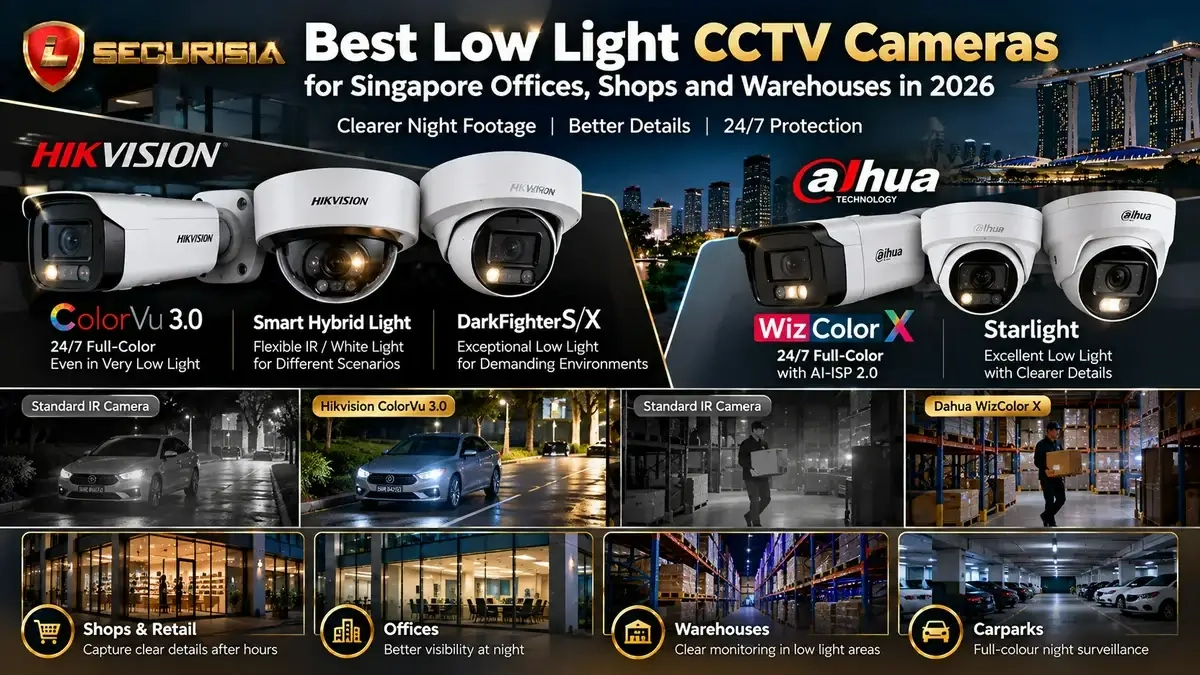
This article focuses on low-light imaging technologies and how to compare them. For general installation planning and pricing, see our CCTV installation guide for Singapore.
Quick answer: Hikvision ColorVu, DarkFighter and Dahua WizColor or Starlight are not interchangeable names for one identical feature. They refer to different imaging approaches and product families, and results vary by exact camera model, sensor, lens, lighting mode, exposure settings and scene. The best choice is the camera that captures useful moving detail in your actual location—not necessarily the product with the strongest headline specification.
Compare exact model numbers and Singapore-market datasheets. Manufacturer series names cover multiple models, and features such as supplemental lighting, AI image processing, WDR, lens options and analytics can vary across models and generations.
1. Why low-light CCTV performance is more than “night vision”
At night, a camera must gather limited light while keeping noise, blur and bright highlights under control. A scene with a lit shopfront and a dark corridor is different from a uniformly dim warehouse aisle. Reflections from glass, vehicle headlights, rain and moving people all affect the result.
The useful question is not simply whether a camera can display a colour image in darkness. Ask whether it can retain the detail required for the task: a person's face at an entrance, clothing and direction of travel, stock movement at a loading bay or a vehicle moving through a carpark.
2. Hikvision ColorVu and ColorVu 3.0
ColorVu is Hikvision's low-light colour-imaging family. Current public product information includes ColorVu 3.0 on selected Pro Series cameras, with features such as HikAI-ISP image processing, F1.0 Super Confocal Lens and Smart Hybrid Light depending on the model. Smart Hybrid Light models can offer IR, white-light and smart lighting modes; in supported configurations, the camera can stay in IR and switch to colour illumination when an event is detected.
This approach can help when colour details—such as clothing, vehicle colour or a carried object—are important during night review. However, do not assume every ColorVu model has the same lens, sensor, white-light range or analytics. Confirm the exact product specification and which features are enabled on the chosen recorder or software.
Manufacturer references: Hikvision ColorVu 3.0 Pro Series and Hikvision Smart Hybrid Light with ColorVu.
3. Hikvision DarkFighter, DarkFighterS and DarkFighterX
DarkFighter is another Hikvision low-light imaging family. It is important not to treat every suffix as the same generation or configuration:
- DarkFighter / DarkFighterS: selected models use larger apertures, advanced sensors and image processing to improve low-light output. Hikvision's current DarkFighterS technology page describes F1.0 Super Aperture, Super Confocal Lens and flexible lighting options on supported products.
- DarkFighterX: a distinct series described by Hikvision as using dual-sensor, bi-spectral fusion to combine information from visible-light and infrared imaging into a full-colour image.
These product names do not guarantee an identical result. Check the model's minimum-illumination conditions, lens, sensor size, WDR, night mode and supplemental lighting. The DarkFighterX architecture is different from DarkFighterS; do not assume one is a direct one-for-one replacement for the other.
Manufacturer references: Hikvision DarkFighterS technology and Hikvision DarkFighterX series. Regional model availability can differ, so confirm the Singapore SKU with the supplier.
4. Dahua WizColor and WizColor X
WizColor is Dahua's low-illumination colour-imaging technology family. On listed models, Dahua combines a large-aperture lens and a larger-pixel sensor to gather more light; exact aperture, sensor dimensions, resolution and supplemental lighting are model-dependent.
WizColor X is a more recent technology direction on Dahua's public product site. Dahua describes it as combining AI-ISP 2.0, larger-pixel sensors and its UltraSight Lens approach. Some listed WizColor X products specify an F0.8 lens; this should not be generalised to every WizColor camera. The manufacturer says the updated processing is designed to preserve moving-target detail and reduce motion blur in very dark scenes.
When evaluating a WizColor camera, check not only its ability to brighten a still image but also whether a walking person or moving vehicle remains clear at the shutter speed and frame rate you intend to record.
Manufacturer reference: Dahua WizColor and WizColor X technology.
5. Dahua Starlight: treat it as a model-specific low-light label
Starlight appears on certain Dahua low-light camera families and models. It is an established technology label, not a reliable shortcut for deciding that a camera is newer or better than a WizColor X model. Performance depends on the specific sensor, lens, exposure behaviour, image processing and illumination options.
Some Starlight models aim to retain colour in low illumination; others may rely on IR or supplemental light to handle darker conditions. Read the exact datasheet for the model you are considering, and check whether its stated minimum illumination applies with the specified aperture, gain and lighting configuration.
Do not compare lux figures from different datasheets as if they were measured under identical conditions unless the test methodology and settings match.
6. Quick comparison: which family should you shortlist?
| Technology family | What to investigate | Potential fit | Key caution |
|---|---|---|---|
| Hikvision ColorVu / ColorVu 3.0 | Low-light colour performance, lens and sensor, HikAI-ISP on supported models, Smart Hybrid Light modes | Entrances, shopfronts and business areas where colour detail is useful | White-light behaviour, lens variant and analytics differ by model |
| Hikvision DarkFighter / DarkFighterS | Sensor sensitivity, F1.0 options, noise processing, WDR and available lighting modes | Dim indoor areas, commercial sites and challenging scenes where low-light imaging is a priority | Confirm the exact series suffix and specification |
| Hikvision DarkFighterX | Dual-sensor architecture, bi-spectral fusion, lens and deployment requirements | Applications that specifically suit the selected dual-sensor model | Different architecture; do not assume it matches DarkFighterS |
| Dahua WizColor / WizColor X | Sensor pixel size, aperture, AI-ISP generation, lens and motion detail | Low-light areas where colour and moving-object detail matter | F0.8 and other headline features apply only to specified models |
| Dahua Starlight | Exact sensor, lens, minimum-illumination test conditions, IR and WDR | Suitable Starlight-labelled models that meet the scene's real requirements | The label alone does not show generation or comparative superiority |
This is a shortlisting guide rather than a laboratory ranking. The manufacturer's naming and features can change by region and model; availability in Singapore should be confirmed against the exact part number and current datasheet.
7. Match low-light technology to the location
Shopfronts and entrances
Prioritise usable facial and clothing detail at the actual distance, with backlight handling for glass doors and lit signboards. If colour at night is important, assess what supplemental white light the camera uses and whether it is appropriate for the premises.
Warehouses and loading bays
Check both broad scene visibility and evidence-focused views near loading doors, dispatch points and vehicle routes. Large dark spaces may require different lens and lighting choices from a well-lit packing area. See our warehouse CCTV coverage guide for site-planning considerations.
Back lanes, carparks and external perimeters
Test the camera with real moving people and vehicles, reflective surfaces and headlight glare. For licence plates or distant faces, a dedicated tighter view may be more useful than a single wide-angle camera.
Offices and corridors
Do not select night performance in isolation if the area is lit by motion-controlled lights or has bright and dark zones in the same frame. Confirm the image remains usable as the lighting changes.
8. What to compare on the datasheet
- Sensor size and lens aperture: both affect how much light reaches the sensor, but they are not the only factors that determine the final image.
- Minimum illumination: read the testing conditions, including aperture, gain, shutter and whether supplemental light is active.
- Shutter and motion blur: very slow shutter speeds can brighten a still scene but smear a moving subject.
- Lighting mode: identify whether the camera uses IR, visible white light, warm light or a hybrid mode, and how the modes are triggered.
- WDR and bright highlights: useful where a bright entrance sits beside a dark interior, but confirm performance in your real scene.
- Resolution, frame rate and compression: ensure the required detail and recording settings are supported by the NVR and available storage.
- Lens choice: a varifocal lens can help frame a critical doorway or vehicle route more precisely when supported by the model.
- Recorder compatibility: confirm codec, stream, firmware, analytics and any licence or integration requirements.
9. The fairest way to test cameras before deciding
Where possible, arrange a site trial or side-by-side review using the exact shortlisted models. Compare them under the same scene and settings rather than judging from separate marketing images.
- Test at the real darkest time and with the existing site lighting.
- Record a person walking across the frame and towards the camera.
- Check face and clothing detail at the expected distance.
- Test bright headlights, glass reflections and changing illumination.
- Review playback at the planned resolution, frame rate and compression.
- Check whether visible supplemental light is acceptable for neighbours, staff and the use of the premises.
A camera can look bright and attractive in a still image while producing motion blur in recorded video. The final decision should be based on the evidence quality you actually need.
10. Common buying mistakes
- Assuming ColorVu, DarkFighter, Starlight and WizColor are equivalent technologies.
- Assuming a new series name automatically means better footage in every scene.
- Judging the image only from a bright showroom or a manufacturer's demo video.
- Ignoring visible supplemental light, motion blur or backlight from glass.
- Comparing quoted lux ratings without checking how they were measured.
- Choosing the camera before deciding what must be recognisable in recorded footage.
Shortlist the appropriate technology family, then compare exact models against the site's lighting, viewing distance, lens requirement and recording setup. A professional site assessment can help determine whether ColorVu, DarkFighter, WizColor, Starlight or another configuration is the most suitable fit.
Frequently asked questions
Is ColorVu better than DarkFighter?
Not in every situation. They refer to different Hikvision technology families and product configurations. Compare the specific camera models, sensor, lens, lighting modes and recorded motion detail.
Is Dahua WizColor newer than Starlight?
WizColor and WizColor X are Dahua's more recent low-light colour technology direction on its current technology site. Starlight remains a label used on specific models, so compare the exact product datasheets rather than treating the names as a universal generation ranking.
Can low-light CCTV record colour in complete darkness?
A camera needs some usable light to capture natural colour. In near-total darkness, colour output may depend on supplemental visible illumination or a specialised imaging design. Check the model's stated operating conditions and test it in the actual environment.
Does higher resolution guarantee better night footage?
No. Resolution is only one factor. Light sensitivity, lens, exposure, noise reduction, shutter speed, lighting and the movement of the subject all affect practical image quality.
Manufacturer references
- Hikvision ColorVu 3.0 Pro Series
- Hikvision Smart Hybrid Light with ColorVu
- Hikvision DarkFighterS technology
- Hikvision DarkFighterX series
- Dahua WizColor and WizColor X technology
Manufacturer pages describe the features of their own technologies. Specifications and performance claims are manufacturer-provided and are not a direct independent head-to-head test. Confirm Singapore-market availability, product number and current datasheet before purchasing.