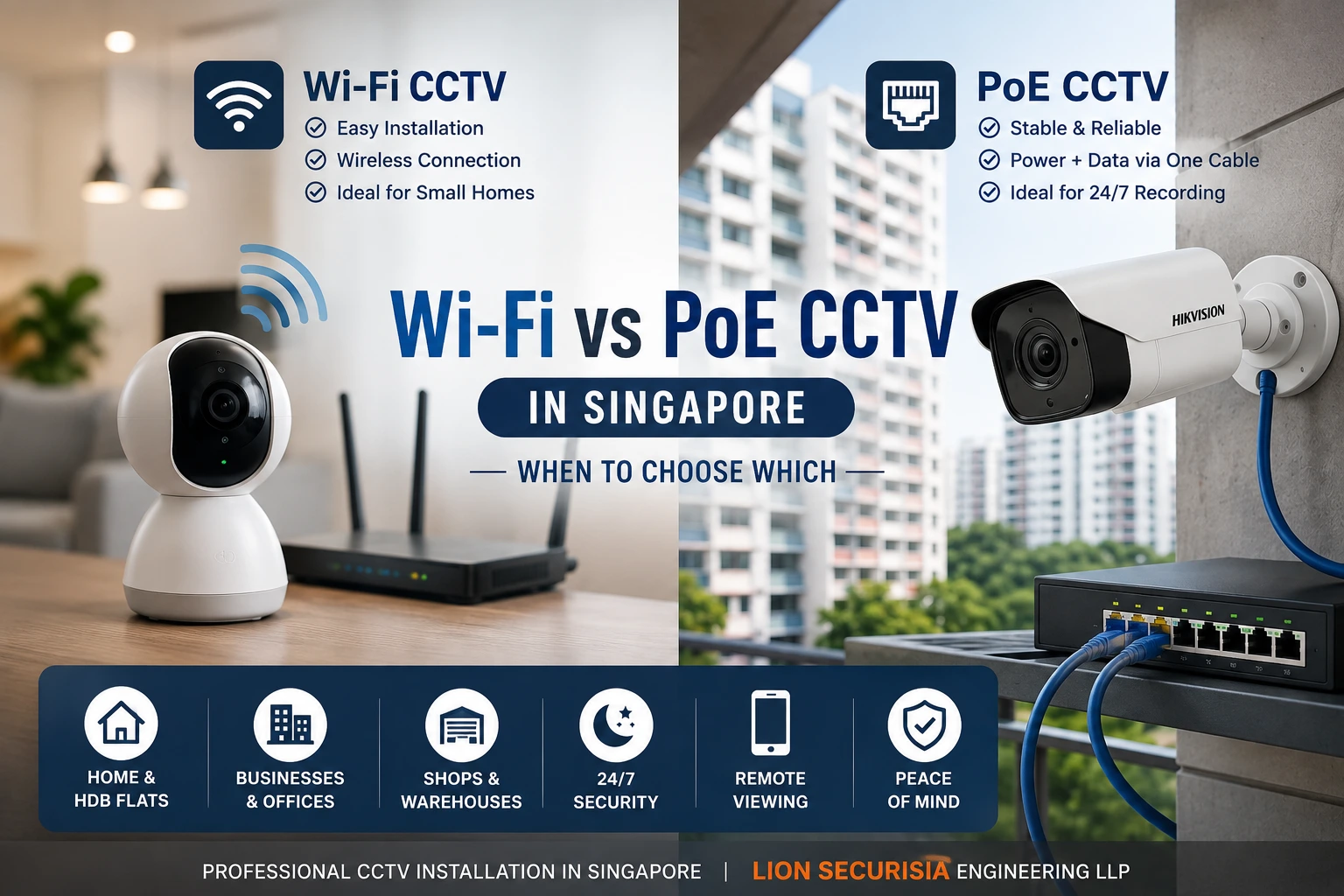
Understanding the Difference Between Wi-Fi and PoE CCTV
One of the most common questions homeowners and business owners ask is whether they should install Wi-Fi CCTV cameras or a wired PoE (Power over Ethernet) CCTV system. Both technologies have advantages, but the right choice depends on your property, installation requirements and long-term security expectations.
Wi-Fi cameras focus on convenience and flexible placement, while PoE systems provide a wired network connection and can support centralised recording when paired with a compatible recorder and adequate storage. Understanding the differences helps you choose a system that meets your needs rather than simply selecting the lowest initial price.
Wi-Fi CCTV Cameras: Flexible and Easy to Install
Wi-Fi CCTV cameras communicate through your wireless network, reducing the need for network cabling between the camera and recorder. Most models still require a nearby power source, although some battery-powered cameras are available. Installation requirements vary by model.
Wi-Fi cameras can be suitable for homeowners who need basic monitoring without extensive renovation work or long cable runs.
Advantages of Wi-Fi CCTV
- Flexible camera placement where wireless coverage is sufficient
- Less network cabling to install
- Convenient for some rental properties
- Relatively easy to relocate when needed
- Useful for indoor monitoring
- Potentially lower initial installation cost in suitable locations
Things to Consider
Wi-Fi cameras depend on wireless signal quality. Weak coverage, network congestion or router interruptions may affect live viewing and network recording. Some models can continue local recording during an internet outage, but this depends on the camera, local storage, recorder configuration and power supply.
When choosing camera locations, consider both the field of view and the strength of the wireless signal. A strong internet connection alone does not guarantee strong Wi-Fi coverage at every camera position.
PoE CCTV Systems: Wired Connectivity and Centralised Recording
PoE (Power over Ethernet) CCTV systems use a compatible Ethernet cable, often Cat6 in new installations, to deliver both network data and power to each camera. A properly designed wired connection avoids reliance on Wi-Fi signal strength between cameras and the network.
For homeowners and businesses planning a permanent multi-camera installation, PoE can offer predictable network connectivity and convenient centralised recording. Recording continuity still depends on configuration, recorder health, storage, power and maintenance.
Advantages of PoE CCTV
- Wired network connectivity
- Suitable for continuous recording when correctly configured
- Centralised recording with a compatible NVR
- Support for high-resolution cameras, depending on equipment specifications
- Practical for larger multi-camera systems
- Can make future expansion easier when planned properly
- Less dependence on wireless signal conditions
Things to Consider
PoE usually requires network cabling to each camera, so the route, concealment method, mounting height and building conditions affect installation work. The recorder and network equipment also need appropriate power and ventilation. Backup power can be considered where recording during power interruptions is important.
Wi-Fi vs PoE CCTV: Quick Comparison
| Factor | Wi-Fi CCTV | PoE CCTV |
|---|---|---|
| Connectivity | Wireless network | Ethernet cable |
| Camera power | Usually local power; some models use batteries | Can receive power over compatible Ethernet |
| Installation | Often simpler where Wi-Fi is strong | Requires cable routing to each camera |
| Recording | Depends on local storage, cloud or recorder support | Often paired with an NVR for centralised recording |
| Best fit | Flexible placement and simpler setups | Permanent multi-camera installations |
Which System Is Better for HDB Homes?
For smaller HDB flats where running network cables is difficult, Wi-Fi cameras can provide a practical solution for monitoring entrances or indoor living areas. Check wireless coverage at the intended camera positions and confirm how footage will be stored.
For a permanent setup with several cameras, PoE may be suitable because it provides a wired connection and can simplify centralised recording. The right choice also depends on cable routing, property layout, installation requirements and the amount of footage you want to retain.
What Should Businesses Consider?
Retail shops, offices, warehouses, clinics and other commercial premises may need several cameras, consistent recording and centralised playback. PoE can be a strong option when the system is designed around suitable cabling, network equipment, recorder capacity and storage.
Wi-Fi cameras can still be useful in selected locations where network cabling is difficult or where a flexible supplementary camera is appropriate. The system design should consider security priorities, coverage, recording retention, remote access and maintenance requirements.
For a permanent multi-camera system, PoE is often worth considering for wired connectivity and centralised recording. Wi-Fi may be more practical where flexible placement and reduced network cabling are priorities. Some properties benefit from using both technologies.
Can You Combine Wi-Fi and PoE Cameras?
A hybrid CCTV setup can combine PoE and Wi-Fi cameras where the selected cameras, recorder or management platform support that arrangement. For example, PoE cameras might cover important entrances and outdoor areas, while Wi-Fi cameras monitor indoor locations where installing Ethernet is impractical.
Before combining systems, confirm compatibility, recording behaviour, user access, mobile viewing and how footage from each camera will be stored and retrieved.
Factors to Consider Before Choosing
- Property type: HDB, condominium, landed home or commercial site
- Number of cameras and coverage requirements
- Existing network infrastructure and Wi-Fi coverage
- Cable routes, concealment and mounting conditions
- Recording mode and required retention period
- Recorder, storage and backup power requirements
- Budget for equipment, installation and maintenance
- Future expansion plans and remote viewing needs
Final Thoughts
There is no single answer for every property when comparing Wi-Fi and PoE CCTV. Wi-Fi offers convenience and flexible placement, while PoE can provide more predictable network connectivity and practical centralised recording for multi-camera installations. Both systems still need suitable power, configuration, storage and maintenance to deliver usable footage.
Lion Securisia Engineering assesses each property individually and recommends CCTV options based on the site, desired coverage, cabling requirements, recording needs and future plans.
Frequently Asked Questions
Which is better, Wi-Fi CCTV or PoE CCTV?
PoE provides a wired network connection and can suit permanent multi-camera systems. Wi-Fi offers more flexible placement where cabling is difficult. Performance depends on the network, power, camera configuration and recording setup.
Is PoE CCTV better for HDB flats?
For permanent installations with multiple cameras or centralised recording, PoE may be suitable. Wi-Fi cameras can be practical for simple indoor monitoring or where cable routing is not feasible. Consider the flat layout, cabling options and recording requirements.
Can Wi-Fi CCTV work without Internet?
Some Wi-Fi cameras can record locally to a memory card or compatible recorder without Internet access. Remote viewing and cloud-based features generally require connectivity. Capabilities vary by model and configuration.
Does PoE CCTV require Wi-Fi?
No. PoE cameras use Ethernet for data and power through a compatible PoE switch or recorder. Internet access is generally needed for remote viewing from outside the local network, but not necessarily for local recording.
Which CCTV system is recommended for businesses?
PoE is often a suitable option for offices, warehouses and retail premises that need multiple cameras and centrally managed recording. The best system depends on the site layout, retention requirements, network design and budget.
Can Wi-Fi and PoE cameras be used together?
Yes, where the selected cameras and recorder or management platform support the combination. A hybrid design can use PoE for important coverage and Wi-Fi cameras where installing Ethernet is impractical.